
So Many Rules
Follow-up on Roadless Rule Comment Period | Interior Attacks Another Policy: the Public Lands Rule

Follow-Up on Roadless Rule Comment Period
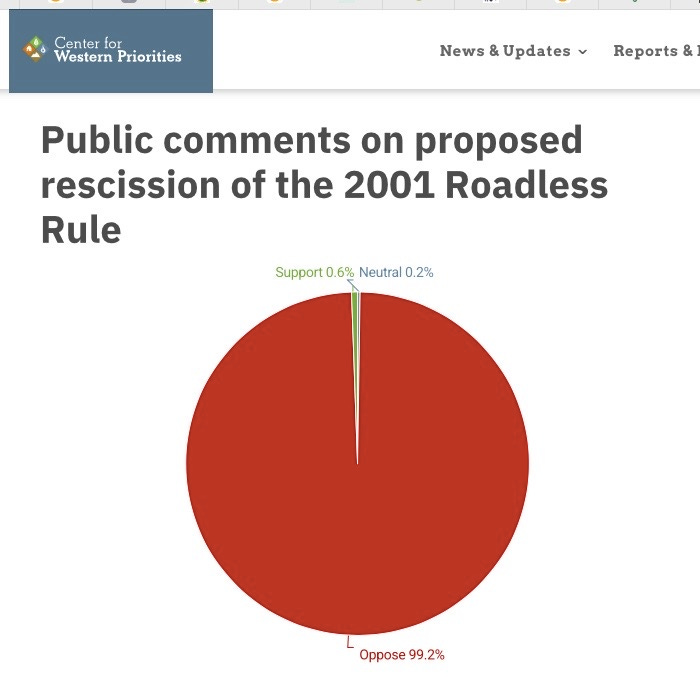
If you took action during the Roadless Rule public comment period in September, Thank You! I was following along at the federal website that accepted comments and I saw that there were around 180,000 comments submitted. On the last day before the deadline, an outfit called the Center for Western Priorities did a statistical analysis of a 5000 comment sample: Over 99% of the comments wanted to keep the Roadless Rule.
I thought, Gee, 180k comments is pretty good, considering that it was only a three week comment period. Come to find out that a batch of comments was delivered on the last day of around 400,000 comments. So, the sum total was over 600k comments. I don’t know how long the comment period was in 2001 when the Roadless Rule was initiated, but they collected 1.6 million comments back then. 600k is over a third of that number and in just three weeks.
I can’t think of another topic where the American public is this united.
So, get ready. Watch this Republican administration completely disregard the public commentary and eliminate the Roadless Rule anyway. That’s my prediction. I also predict that the overwhelming public support for the Roadless Rule will be dismissed as rigged somehow. Bonus points if they use the word “leftist.”
Interior Attacks Public Lands Rule
Ready for school on another rule? The previous administration passed something called the Conservation and Landscape Health Rule, also known as the Public Lands Rule. It affects 245 million acres of Bureau of Land Management (BLM) land which is administered by the Department of Interior (DOI). It puts “conservation, recreation, wildlife habitat, and cultural resources” on equal footing with all of the other uses of public land like mining, logging, and grazing. Outdoor recreation has a $1.2 trillion economic impact in this country. Much of that takes place on public land. The Public Lands Rule puts conservation and outdoor recreation on equal footing with extractive industries.
Naturally, Burgum at the Department of Interior is proposing to eliminate this Public Lands Rule because, this administration is strongly in support of all extractive industries. They favor a short-sighted one-time burst of cash over any possibility of thinking in a timeline that exceeds a single lifetime. Like the Republican action to get rid of the Roadless Rule, this also involves tearing down a policy, not creating one. And, much like the public commentary about the Roadless Rule, the public comments were 92% in favor of the Public Lands Rule. The public? Screw them.
Forest Reserves, which were the 19th century precursors to our first national parks, were initially created to protect the headwaters of our rivers. Partly because the rivers were being decimated by the effects of logging and grazing. As industries try to punch a road into every last remaining corner of our public lands, the last administration correctly established that the land serves a vital purpose for us all just by existing.
This attempt to reverse the Public Lands Rule reminds me of the contentious debate around the creation of the Wilderness Act of 1964. Ultimately, LBJ signed the act into law and we get places like the Boundary Waters Canoe Area Wilderness and the Collegiate Peaks Wilderness, both of which I visited this year.
In 1960, during the leadup to the creation of the Wilderness Act, one of my favorite writers, Wallace Stegner, wrote a famous public comment (just like we all did about the Roadless Rule). It’s called The Wilderness Letter. The current Republican decision to eliminate the Public Lands Rule challenges us to ask ourselves yet again: Who are we? Stegner was talking about wilderness, but his comments remind me of this Public Lands Rule debate right now. How do we treat our land? What does that say about us as a nation? The letter is long and it’s hard to cherry-pick portions of it. I recommend you read the whole thing, because the overall effect is more powerful than individual lines. Still, here’s the part that I think about:
Something will have gone out of us as a people if we ever let the remaining wilderness be destroyed; if we permit the last virgin forests to be turned into comic books and plastic cigarette cases; if we drive the few remaining members of the wild species into zoos or to extinction; if we pollute the last clear air and dirty the last clean streams and push our paved roads through the last of the silence, so that never again will Americans be free in their own country from the noise, the exhausts, the stinks of human and automotive waste. And so that never again can we have the chance to see ourselves single, separate, vertical and individual in the world, part of the environment of trees and rocks and soil, brother to the other animals, part of the natural world and competent to belong in it. Without any remaining wilderness we are committed wholly, without chance for even momentary reflection and rest, to a headlong drive into our technological termite-life, the Brave New World of a completely man-controlled environment. We need wilderness preserved--as much of it as is still left, and as many kinds--because it was the challenge against which our character as a people was formed.
You know that movie The Martian where Matt Damon is growing potatoes to keep himself alive? There are certain people, like those in the current Republican administration, who would absolutely scrape the Earth clean down to the bedrock for cash. Then the rest of us will all be standing there in a circle around the last surviving field of potatoes in the world and thinking, You know, maybe we should’ve lived differently. The billionaires would sell us the air we breathe, if they could get away with it.
Call to Action: Public Lands Rule
Please take action to Keep the Public Lands Rule. Conservation is a valid use of our public land, just like timber, grazing, and mining. Since we only care about money, I’d remind you that outdoor rec is a $1.2 trillion economic engine.
At some point, the land’s value as an oxygen source, water pump, and food source will far exceed its value for what you can strip out of it. Arguably, it already does. We just don’t realize it yet.
Most importantly, click here by Nov10th to tell the DOI to Keep the Public Lands Rule.
Also, click here to send an email to your elected officials to Keep the Public Lands Rule.
Outdoor Alliance’s sample text you might find useful in your DOI public comment in the first link:
I am an avid outdoor recreationist and I’m writing to share my support for the Bureau of Land Management’s Public Lands Rule.
The rule is a long overdue way to deliver on the BLM’s mission of protecting multiple uses, including conservation. BLM lands are managed for multiple use and sustained yield, but too often the agency is managing lands in a way that is not, in fact, sustainable. To deliver on its mandate, BLM needs to do more to conserve all lands, not just those with special designations like Wilderness. BLM lands are under more stress than ever before, and I’m pleased to see the agency taking steps to plan for a thoughtful increase in renewable energy development and manage for the effects of climate change and increased use.
Thanks for your consideration.